
India marks major nuclear milestone
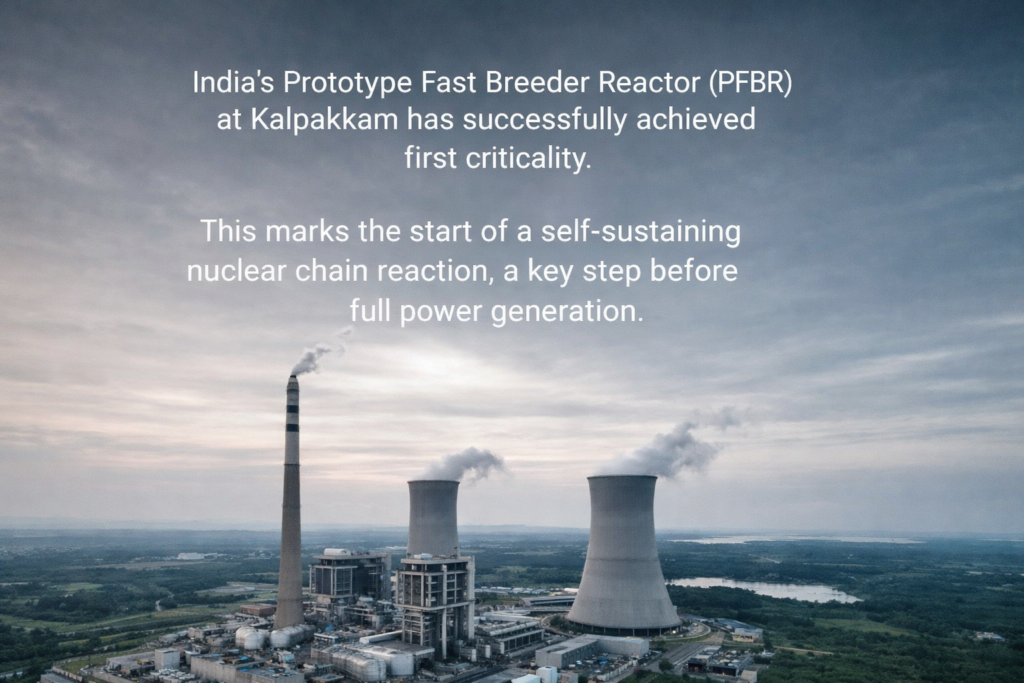
The attainment of criticality at the 500 MWe Prototype Fast Breeder Reactor (PFBR) in Kalpakkam is a definitive success for India’s energy sovereignty. Developed indigenously by BHAVINI with over 200 domestic partners, this milestone makes India only the second nation after Russia to operate a commercial-scale fast breeder reactor.
Achieving criticality means that the reactor has initiated a self-sustaining nuclear fission chain reaction, indicating readiness for eventual power generation.
A Fast Breeder Reactor (FBR) is a type of nuclear reactor that generates more fissile material than it consumes.
Unlike conventional reactors, which use thermal (slow) neutrons, FBRs use fast neutrons to sustain nuclear fission. This allows efficient utilisation of fuel and enhances energy output.
FBRs are crucial for countries like India that have limited uranium reserves but abundant thorium resources.
Strategic Context: The Three-Stage Nuclear Program
- India’s 3-Stage Nuclear Power Programme is designed to harness the nation’s nuclear resources for sustainable energy production while ensuring long-term energy security. It was formulated by well-known physicist Dr. Homi Bhabha.
- Objective: It focuses on efficiently using India’s limited uranium resources while maximizing the potential of thorium, which is more abundant in the country.
This achievement is the vital link in the roadmap designed by Dr. Homi J. Bhabha to utilize India’s vast thorium reserves.
- Stage I (PHWRs): Uses natural uranium to generate power and produce Plutonium-239.
- Stage II (The PFBR Milestone): Utilizes Stage I plutonium to “breed” more fuel than it consumes. By converting fertile material into fissile fuel, it acts as a fuel multiplier.
- Stage III (Thorium Utilization): The ultimate goal. Once Stage II builds sufficient fuel inventory, India will transition to reactors fueled by Thorium, ensuring centuries of energy security.
Why can’t Skip Stage 2
1. Thorium is not directly usable
- Thorium-232 ≠ fissile fuel
- Thorium itself is not fissile — it cannot sustain a chain reaction on its own
It must first be converted into U-233, which happens in Stage
Technical Significance of Stage 2
| Feature | Detail |
|---|---|
| Coolant | Liquid Sodium (highly efficient but technically demanding). |
| Mechanism | Uses Fast Neutrons to extract ~60x more energy from uranium. |
| Impact | Drastically reduces long-term nuclear waste while maximizing fuel. |
By mastering the “closed fuel cycle” in Stage II, India has successfully bridged the gap between its uranium-limited present and a thorium-powered future & to achieve India’s goal of 100GW by 2047
Prelims PYQ
Prelims(2020)
Q. In India, why are some nuclear reactors kept under “IAEA safeguards” while others are not?
(a) Some use uranium and others use thorium
(b) Some use imported uranium and others use domestic supplies
(c) Some are operated by foreign enterprises and others are operated by domestic enterprises
(d) Some are State-owned and others are privately owned
Ans: (b)