
Climate-Resilient Water Management: India’s New Strategy for Water Security
22 September 2026 | Current Affairs | Environment | UPSC | APPSC | SSC | State PSC
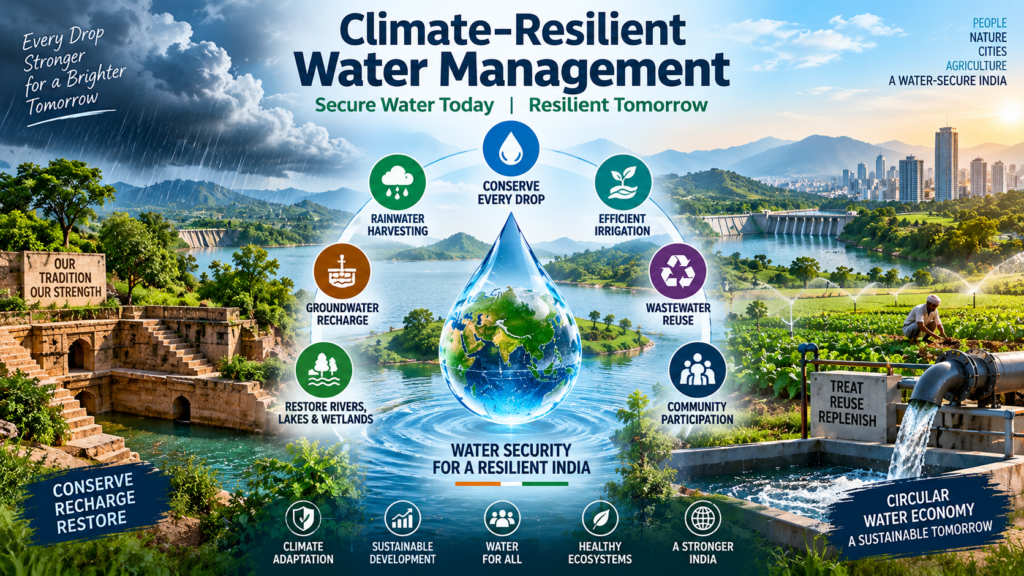
India’s water challenge is changing rapidly. Climate change is causing erratic rainfall, intense floods, longer dry periods, groundwater depletion and increasing water stress. Against this backdrop, the 9th India International Water Week (IIWW) in New Delhi focused on “Climate-Resilient Water Management.”
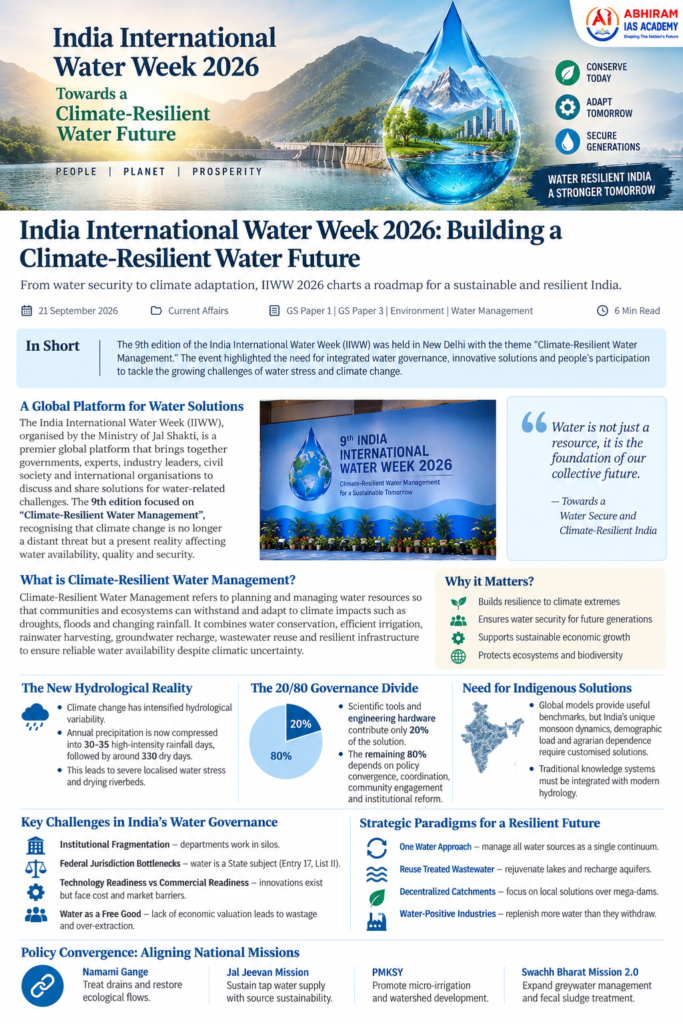
What is Climate-Resilient Water Management?
It means managing water resources so that communities, agriculture and ecosystems can withstand droughts, floods and changing rainfall patterns.
It combines rainwater harvesting, groundwater recharge, efficient irrigation, wastewater reuse, watershed management and resilient infrastructure.
The basic idea is to shift from managing water crises after they occur to preparing water systems for climate uncertainty.
Why Does India Need It?
India increasingly faces a water paradox: intense rainfall and flooding during one period, followed by water scarcity during another.
The problem is also institutional. Drinking water, irrigation, groundwater, sewage and flood management are often handled separately, even though they form part of the same hydrological cycle.
Water is primarily a State subject under Entry 17 of the State List, making Centre–State and inter-State coordination especially important for effective river-basin management.
One Water Approach
A major solution is the One Water Approach, which treats rainwater, rivers, groundwater, drinking water and wastewater as parts of one interconnected resource.
Rainwater → Surface Water → Groundwater → Drinking Water → Wastewater → Treatment → Reuse
This also supports a Circular Water Economy, moving away from:
Extract → Use → Discard
towards:
Conserve → Use → Treat → Reuse → Recharge
Treated wastewater can therefore become an important resource for industry, agriculture, landscaping and restoration of water bodies.
What Should India Do?
India needs greater emphasis on watershed development, restoration of ponds and wetlands, check dams, rainwater harvesting and groundwater recharge. Agriculture must improve water-use efficiency through drip and sprinkler irrigation, better crop planning and soil-moisture technologies.
Major programmes such as Jal Jeevan Mission, Namami Gange, Pradhan Mantri Krishi Sinchayee Yojana and Swachh Bharat Mission should work through greater policy convergence rather than isolated implementation.
Local communities are equally important. Panchayati Raj Institutions and Urban Local Bodies can undertake community water budgeting, protect local water bodies and monitor groundwater use.
Why is it Important for Competitive Exams?
This topic is important for UPSC Civil Services, APPSC Group 1, APPSC Group 2, TGPSC/TSPSC, BPSC, UPPSC, MPSC, MPPSC, RPSC, KPSC, TNPSC, OPSC, WBPSC, SSC CGL, SSC CHSL, Railways, Banking, NABARD, CDS, NDA, CAPF and other competitive examinations.
For UPSC and State PSCs, connect it with Climate Change, Water Security, Agriculture, Federalism, Disaster Management, Sustainable Development and Environmental Governance.
Quick Revision
9th India International Water Week → Climate-Resilient Water Management → One Water Approach → Circular Water Economy → Rainwater Harvesting → Groundwater Recharge → Wastewater Reuse → Micro-Irrigation → Community Water Budgeting → Integrated River-Basin Management
Conclusion
India’s future water security will depend not simply on finding more water but on managing existing water more efficiently. Integrating modern technology, traditional conservation practices, community participation and better governance can make India’s water systems more resilient to climate change.
SEO Keywords
Climate Resilient Water Management 2026, India International Water Week 2026, IIWW 2026, Water Management UPSC, Water Security India, One Water Approach, Circular Water Economy, Groundwater Recharge, Water Conservation India, Jal Jeevan Mission, Namami Gange, PMKSY, Climate Change Current Affairs, UPSC Current Affairs 2026, APPSC Current Affairs 2026, APPSC Group 1, APPSC Group 2, SSC Current Affairs, State PSC Current Affairs, Environment Current Affairs, General Knowledge 2026, GK Today, Daily Current Affairs, Competitive Exams Current Affairs, Abhiram IAS Academy.