APPSC Group 1 Prelims 2027: Polity Preparation Strategy, Prelims Plan & Polity Module
The APPSC Group 1 Notification 07/2026 has made the preparation phase extremely important for serious aspirants. With 166 Group 1 vacancies and the Screening Test scheduled for 24 January 2027, aspirants now have a limited window to convert their preparation into exam-ready performance.
Among all subjects, Indian Polity and Governance can become a high-return area when prepared through concepts, constitutional provisions, current developments and repeated MCQ practice. Instead of reading Polity as a collection of Articles, aspirants should understand how constitutional institutions actually function.
Here is a crisp APPSC Group 1 Prelims strategy, along with a focused approach to Polity.
1. APPSC Group 1 Notification 2026: Important Details You Must Know
APPSC has released Group 1 Notification No. 07/2026 for 166 vacancies. Applications are open from 6 October to 27 October 2026, up to 11:59 PM, while the Screening Test is scheduled for 24 January 2027.
The Screening Test consists of two objective papers. Paper I – General Studies and Paper II – General Aptitude each contain 120 questions for 120 marks, with 120 minutes available for each paper. Candidates must also be careful about accuracy because the examination carries 1/3rd negative marking for every incorrect answer.
Candidates are expected to be shortlisted for the Mains examination at approximately 50 times the number of vacancies, subject to APPSC rules. For 166 vacancies, this could mean roughly 8,300 candidates moving to the next stage.
Therefore, the objective should not simply be syllabus completion. From now onwards, preparation must move towards revision, accuracy, elimination skills, test practice and score improvement.
2. APPSC Group 1 Polity Strategy: How to Prepare Polity for Prelims
Polity should not be prepared by blindly memorising hundreds of Articles. APPSC can test the same topic through constitutional provisions, institutional powers, exceptions, comparisons and statement-based questions. The right approach is therefore Concept → Constitution → Institution → Current Issue → MCQs.
Begin with the constitutional foundation: historical background, Constituent Assembly, Preamble, Fundamental Rights, Directive Principles, Fundamental Duties, constitutional amendments and Basic Structure doctrine. Once these fundamentals are strong, move systematically to President, Vice-President, Prime Minister, Council of Ministers, Parliament, Supreme Court, Governor, Chief Minister, State Legislature and High Courts.
Next, cover Centre–State relations, federalism, emergency provisions, local government, elections, political parties and constitutional bodies such as the Election Commission, Finance Commission, CAG, UPSC and State Public Service Commissions. Statutory and regulatory institutions relevant to the syllabus should also be studied with their legal basis, composition and functions.
For every institution, follow one fixed framework:
Constitutional/Statutory Basis → Composition → Appointment → Qualification → Tenure → Removal → Powers → Functions → Limitations
This structure is particularly useful for statement-based questions because APPSC may alter just one condition relating to appointment, tenure, removal or jurisdiction.
Current affairs must also be integrated with static Polity. A Supreme Court judgment should take you back to the relevant constitutional provision. An issue concerning a Governor should trigger revision of the Governor’s powers. An Election Commission controversy should lead to Articles, appointment mechanisms and institutional powers.
Chaitanya Dev Sir’s Polity classes are designed around this integrated approach, helping aspirants build conceptual clarity while keeping the preparation focused on the requirements of APPSC Group 1 Prelims.
Download App to get the Module https://play.google.com/store/apps/details?id=co.sheldon.apban
3. APPSC Group 1 Prelims Preparation Strategy: Study, Revise, Test
With the Screening Test approaching, aspirants should avoid the trap of continuously collecting new material. The preparation cycle should now be:
STUDY → REVISE → MCQs → TEST → ANALYSE → REVISE AGAIN
Divide the syllabus into manageable subject blocks and set weekly completion targets rather than unrealistic daily schedules. Every day should contain three essential components: static preparation, current affairs and MCQ practice. Andhra Pradesh-specific topics should run parallel to the general subjects rather than being postponed until the end.
Revision should receive increasing importance as the examination approaches. The first revision can be comprehensive, the second should depend on highlighted notes and important facts, while the final revisions should concentrate on short notes, frequently confused concepts, current affairs and previous test mistakes.
MCQ practice should begin immediately after completing a topic. More importantly, analyse every wrong answer. Identify whether the mistake occurred because of lack of knowledge, poor revision, confusion between two options or unnecessary guessing.
Because the Screening Test carries 1/3rd negative marking, attempting more questions without sufficient accuracy can reduce the final score. Aspirants should therefore develop a personalised attempt strategy through regular mock tests rather than experimenting on the actual examination day.
During the final phase, full-length tests should become increasingly important. A mock test should not merely give you a score; it should tell you what to revise next.
Your final preparation cycle should therefore become:
TEST → FIND YOUR GAPS → REVISE → CORRECT MISTAKES → RETEST
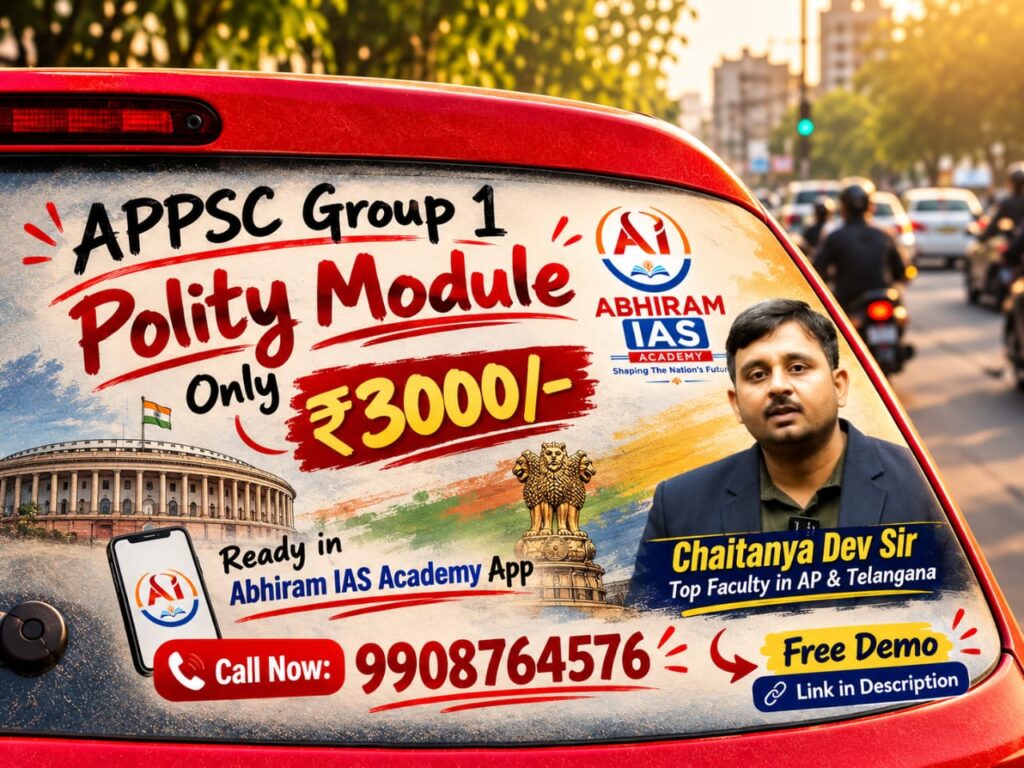
4. APPSC Group 1 Polity Module by Chaitanya Dev Sir – ₹3,000
For aspirants who want focused preparation specifically for Indian Polity and Governance, Abhiram IAS Academy offers an APPSC Group 1 Polity Module by Chaitanya Dev Sir.
The module is designed for aspirants who may already be preparing independently but need a structured Polity course to strengthen concepts, revise the syllabus systematically and approach objective questions with greater clarity.
The focus is on conceptual understanding, constitutional provisions, important Articles, institutions, governance issues, current-affairs integration and APPSC-oriented MCQ preparation rather than simply accumulating notes.
The complete Polity Module is available for ₹3,000 and can be accessed through the Abhiram IAS Academy App, making it useful for aspirants preparing from home as well as working professionals and students who cannot attend regular classroom programmes.
Faculty: Chaitanya Dev Sir
Course: APPSC Group 1 – Polity Module
Fee: ₹3,000
Access: Abhiram IAS Academy App
Contact: 9908764576
With the APPSC Group 1 Screening Test on 24 January 2027, the coming months should not be spent merely reading more material. The priority should be to make every completed subject revision-ready and test-ready.
For Polity especially, remember:
Don’t just memorise Articles. Understand the Constitution, connect it with current issues, practise statements and revise repeatedly.
That is what converts Polity preparation into Prelims marks.