
Nobel Prize Winners 2026 Full List: Medicine, Physics, Chemistry, Literature, Peace & Economics | Important Current Affairs for UPSC, APPSC and TGPSC 2027
The Nobel Prize Winners 2026 are among the important international current affairs topics for UPSC Civil Services Examination 2027, APPSC Group 1, APPSC Group 2, TGPSC Group 1 and TGPSC Group 2 examinations. The Nobel Prizes recognise outstanding contributions to science, literature, peace and economics, making them relevant to General Studies, Science and Technology, International Relations and Current Affairs preparation.
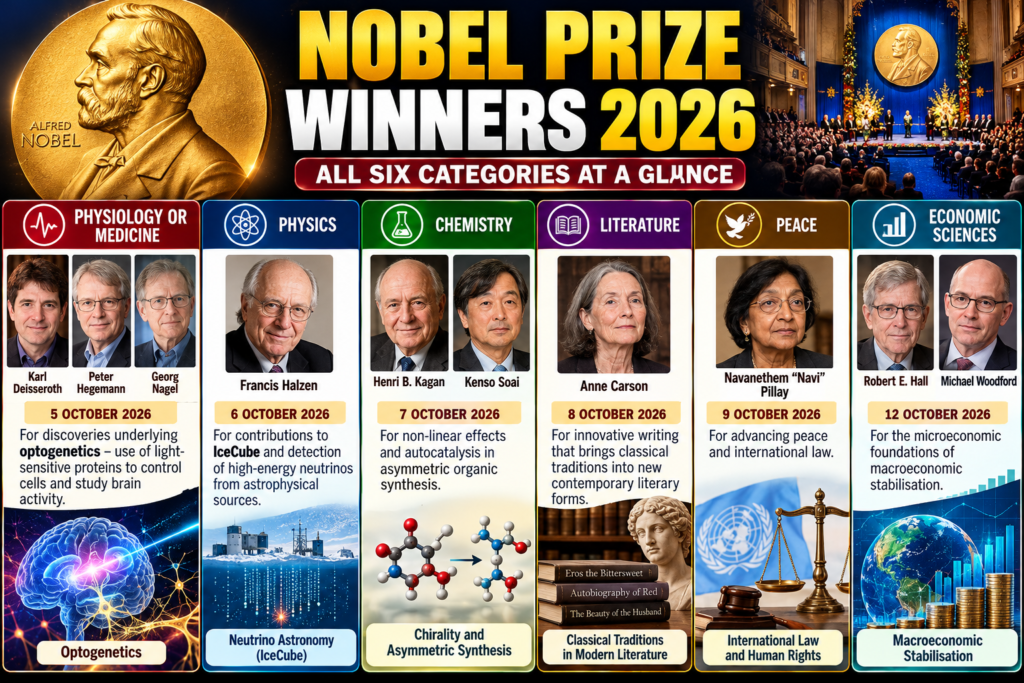
The Nobel Prize 2026 announcements took place from 5 October to 12 October 2026, covering six categories: Physiology or Medicine, Physics, Chemistry, Literature, Peace and Economic Sciences. The awards highlight significant achievements in optogenetics, neutrino astronomy, asymmetric organic synthesis, literature, international justice and macroeconomic stabilisation.
For competitive examination aspirants, understanding the Nobel Prize 2026 winners list, discoveries, award categories, Nobel Prize history and Nobel laureates associated with India is important for developing a comprehensive understanding of international awards and their significance.
1. Nobel Prize 2026 Winners List – All Six Categories, Laureates and Their Contributions
The following table presents the Nobel Prize 2026 winners and their recognised contributions as listed in the study material.
| Nobel Prize Category | Winners 2026 | Major Contribution |
|---|---|---|
| Physiology or Medicine | Karl Deisseroth, Peter Hegemann and Georg Nagel | Discoveries underlying optogenetics |
| Physics | Francis Halzen | High-energy astrophysical neutrinos and the IceCube Neutrino Observatory |
| Chemistry | Henri B. Kagan and Kenso Soai | Non-linear effects and autocatalysis in asymmetric organic synthesis |
| Literature | Anne Carson | Innovative literary writing combining classical traditions and contemporary forms |
| Peace | Navanethem “Navi” Pillay | Contributions to peace, international law and human rights |
| Economic Sciences | Robert E. Hall and Michael Woodford | Microeconomic foundations of macroeconomic stabilisation |
Nobel Prize in Physiology or Medicine 2026 – Optogenetics
The Nobel Prize in Physiology or Medicine 2026 recognises Karl Deisseroth, Peter Hegemann and Georg Nagel for discoveries underlying optogenetics, a scientific technique that combines genetic methods and light to control selected cells.
Optogenetics uses light-sensitive proteins to influence the electrical activity of neurons. Researchers introduce genes encoding these proteins into target cells, enabling them to activate or inhibit selected neurons using appropriate wavelengths of light.
The technique has become important for studying brain circuits, memory, movement, emotions and behaviour. Peter Hegemann and Georg Nagel contributed to understanding channelrhodopsins, while Karl Deisseroth helped develop these discoveries into tools for investigating neural activity.
For UPSC, APPSC and TGPSC Science and Technology preparation, important concepts include optogenetics, channelrhodopsins, genetic engineering and neural circuits.
Nobel Prize in Physics 2026 – Neutrino Astronomy
The Nobel Prize in Physics 2026 recognises Francis Halzen for contributions to the IceCube Neutrino Observatory and the detection of high-energy astrophysical neutrinos.
Neutrinos are electrically neutral elementary particles that interact very weakly with matter. Their ability to travel enormous distances with relatively little interference makes them useful for studying energetic events in the universe.
The IceCube Neutrino Observatory, located in Antarctica, uses sensors embedded in ice to detect light produced by rare particle interactions. These observations help scientists understand high-energy cosmic phenomena.
An important concept is Cherenkov radiation, which occurs when charged particles travel faster than light travels through a particular medium, without exceeding the speed of light in a vacuum.
Neutrino astronomy also contributes to multi-messenger astronomy, which combines information from neutrinos, electromagnetic radiation and gravitational waves.
Nobel Prize in Chemistry 2026 – Chirality and Asymmetric Synthesis
The Nobel Prize in Chemistry 2026 recognises Henri B. Kagan and Kenso Soai for research on non-linear effects and autocatalysis in asymmetric organic synthesis.
Chirality describes molecules whose mirror images cannot be superimposed, similar to the relationship between the left and right hands. These mirror-image molecules are known as enantiomers.
Asymmetric synthesis involves producing one enantiomer preferentially over another. This is particularly important in pharmaceuticals because different enantiomers may produce different biological effects.
Autocatalysis occurs when a product of a chemical reaction catalyses further formation of that product. Asymmetric autocatalysis can amplify a small initial difference in molecular handedness.
These discoveries are relevant to organic chemistry, pharmaceutical development, molecular structure and biotechnology.
Nobel Prize in Literature 2026 – Anne Carson
The Nobel Prize in Literature 2026 recognises Anne Carson, a Canadian poet, essayist, translator and classicist, for her innovative engagement with classical literature and contemporary literary expression.
Her writing combines poetry, prose, translation and scholarship, often reinterpreting ancient mythology through modern experiences.
Her notable works include Eros the Bittersweet, Autobiography of Red and The Beauty of the Husband.
Her literary contribution illustrates the continuing influence of classical traditions on modern literature and creative expression.
Nobel Peace Prize 2026 – Navanethem “Navi” Pillay
The Nobel Peace Prize 2026 recognises Navanethem “Navi” Pillay, a South African jurist of Indian ancestry, for her contributions to international law, human rights and international justice.
Pillay served in important international institutions, including the International Criminal Tribunal for Rwanda, International Criminal Court and United Nations human rights system.
She served as the UN High Commissioner for Human Rights from 2008 to 2014.
Her participation in the 1998 Akayesu judgment is particularly significant because the judgment recognised that rape and sexual violence could constitute genocide when the necessary genocidal intent was established.
For UPSC and State Public Service Commission examinations, her work connects with international humanitarian law, human rights, the International Criminal Court and the International Court of Justice.
Nobel Prize in Economic Sciences 2026 – Macroeconomic Stabilisation
The Nobel Prize in Economic Sciences 2026 recognises Robert E. Hall and Michael Woodford for research on the microeconomic foundations of macroeconomic stabilisation.
Their work explains how individual decisions by households and firms influence broader economic outcomes such as inflation, employment, investment, consumption and economic growth.
Microeconomic foundations connect household and business decisions with economy-wide economic behaviour.
Macroeconomic stabilisation seeks to reduce damaging fluctuations in economic activity through monetary and fiscal policies.
An important dimension of this research is the role of economic expectations, including expectations about future prices, income and interest rates.
These concepts are relevant to UPSC Economy, APPSC Economy and TGPSC Indian Economy preparation.
2. History of Nobel Prizes – Alfred Nobel, Origin, Categories and Awarding Institutions
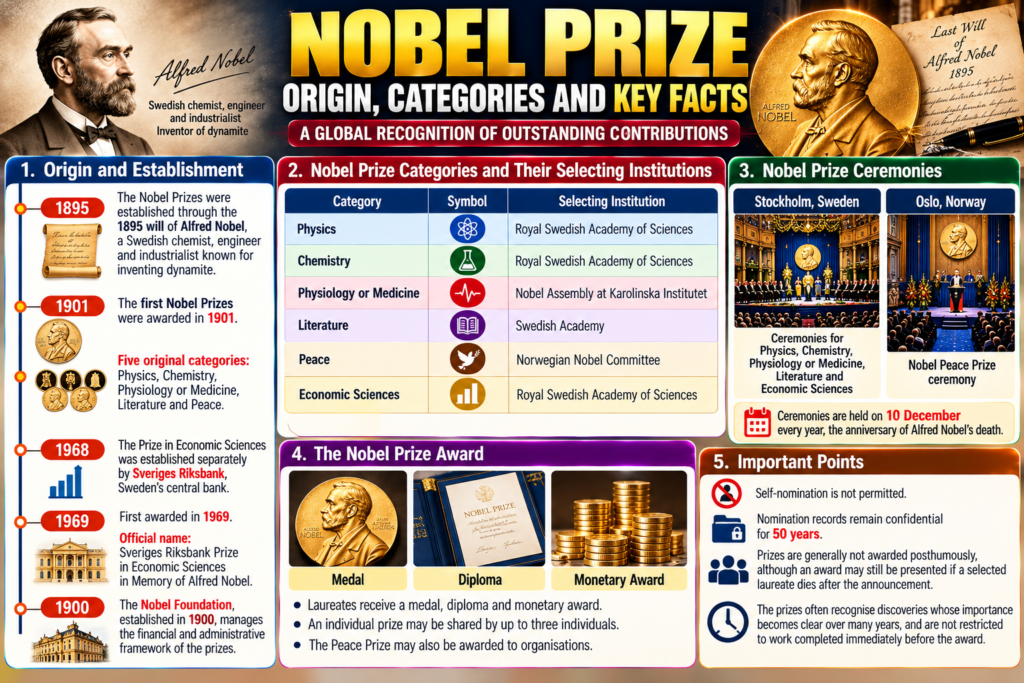
The Nobel Prizes were established through the 1895 will of Alfred Nobel, a Swedish chemist, engineer and industrialist known for inventing dynamite.
The first Nobel Prizes were awarded in 1901.
Alfred Nobel originally established five prize categories: Physics, Chemistry, Physiology or Medicine, Literature and Peace.
The Prize in Economic Sciences was established separately in 1968 by Sveriges Riksbank, Sweden’s central bank, and was first awarded in 1969.
Its official name is the Sveriges Riksbank Prize in Economic Sciences in Memory of Alfred Nobel.
The Nobel Foundation, established in 1900, manages the financial and administrative framework of the prizes. The responsibility for selecting laureates belongs to designated institutions.
| Nobel Prize | Selecting Institution |
|---|---|
| Physics | Royal Swedish Academy of Sciences |
| Chemistry | Royal Swedish Academy of Sciences |
| Physiology or Medicine | Nobel Assembly at Karolinska Institutet |
| Literature | Swedish Academy |
| Peace | Norwegian Nobel Committee |
| Economic Sciences | Royal Swedish Academy of Sciences |
The Nobel Prize ceremonies traditionally take place on 10 December, the anniversary of Alfred Nobel’s death.
The Nobel Peace Prize ceremony is held in Oslo, Norway, while the other Nobel Prize ceremonies take place in Stockholm, Sweden.
Nobel laureates receive a medal, diploma and monetary award. An individual Nobel Prize may be shared by up to three individuals, while the Peace Prize may also recognise organisations.
Self-nomination is not permitted, and nomination records remain confidential for 50 years. Nobel Prizes are generally not awarded posthumously, although an award may still be presented when a selected laureate dies after its announcement.
3. Indian Nobel Prize Winners and Nobel Laureates Associated with India – Important for UPSC, APPSC and TGPSC
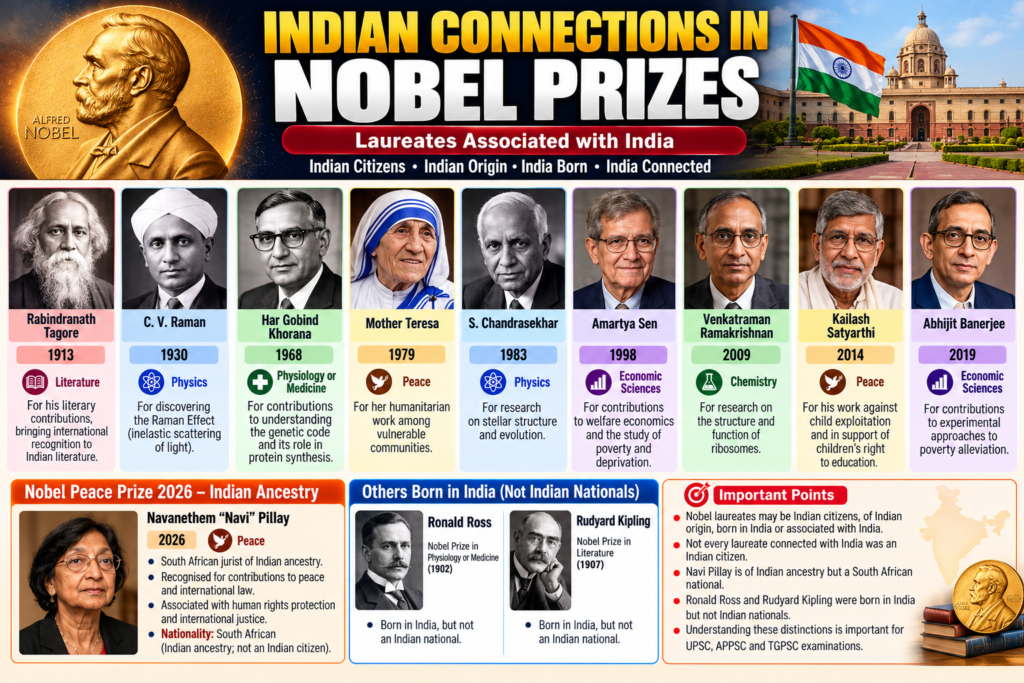
The Nobel Prize has important connections with India through laureates associated with Indian citizenship, ancestry, birthplace or residence. These distinctions are important because not every Nobel laureate connected with India was an Indian citizen at the time of receiving the award.
Rabindranath Tagore received the Nobel Prize in Literature in 1913 for his literary contributions, bringing international recognition to Indian literature.
C. V. Raman received the Nobel Prize in Physics in 1930 for discovering the Raman Effect, which concerns the inelastic scattering of light.
Har Gobind Khorana received the Nobel Prize in Physiology or Medicine in 1968 for contributions to understanding the genetic code and its role in protein synthesis.
Mother Teresa received the Nobel Peace Prize in 1979 for her humanitarian work among vulnerable communities.
Subrahmanyan Chandrasekhar received the Nobel Prize in Physics in 1983 for research on stellar structure and evolution.
Amartya Sen received the Prize in Economic Sciences in 1998 for contributions to welfare economics and the study of poverty and deprivation.
Venkatraman Ramakrishnan received the Nobel Prize in Chemistry in 2009 for research on the structure and function of ribosomes.
Kailash Satyarthi received the Nobel Peace Prize in 2014 for his work against child exploitation and in support of children’s right to education.
Abhijit Banerjee received the Prize in Economic Sciences in 2019 for contributions to experimental approaches to poverty alleviation.
The Nobel Peace Prize 2026 recognition of Navi Pillay adds another important Indian-ancestry connection. However, her nationality is South African, and Indian ancestry should not be confused with Indian citizenship.
Similarly, Ronald Ross and Rudyard Kipling were born in India but should not be categorised as Indian nationals merely because of their birthplace.
Understanding these distinctions is important when preparing questions on Indian Nobel Prize winners, India-born Nobel laureates and Nobel laureates of Indian origin.
4. Nobel Prize Winners 2026 – Important Current Affairs for UPSC Prelims 2027, APPSC Group 1, Group 2 and TGPSC
The Nobel Prize Winners 2026 are relevant to competitive examinations because they connect international recognition with scientific discoveries, literature, human rights, economic theories and global institutions.
For UPSC Prelims 2027, aspirants should focus on Nobel Prize categories, laureates, scientific discoveries, international institutions and the historical background of the awards. Topics such as optogenetics, neutrino astronomy, Cherenkov radiation, chirality, autocatalysis and macroeconomic stabilisation are particularly relevant to Science and Technology and Economy.
For APPSC Group 1 and APPSC Group 2, Nobel Prize 2026 current affairs can be studied under international awards, Science and Technology, General Awareness, Indian Economy and important personalities.
For TGPSC Group 1 and TGPSC Group 2, understanding the Nobel Prize winners and their contributions strengthens preparation in international current affairs, scientific developments, global institutions and economic concepts.
The Nobel Prizes demonstrate how scientific innovation, literature, human rights and economic research contribute to human development and international progress.
At Abhiram IAS Academy, Ashok Nagar, Hyderabad, aspirants preparing for UPSC, APPSC and TGPSC examinations can strengthen their current affairs preparation through structured learning, comprehensive study material, test series and personalised mentorship.
Prepare for UPSC CSE 2027, APPSC Group 1, APPSC Group 2, TGPSC Group 1 and TGPSC Group 2 with Abhiram IAS Academy.
Website: www.abhiramias.com
Contact: 9908764576 | 9908937111
Location: Ashok Nagar, Hyderabad