PM Vishwakarma Scheme Completes 3 Years: 30 Lakh Artisans Registered | Current Affairs 2026 for UPSC, SSC, Banking, Railways & State PSC Exams
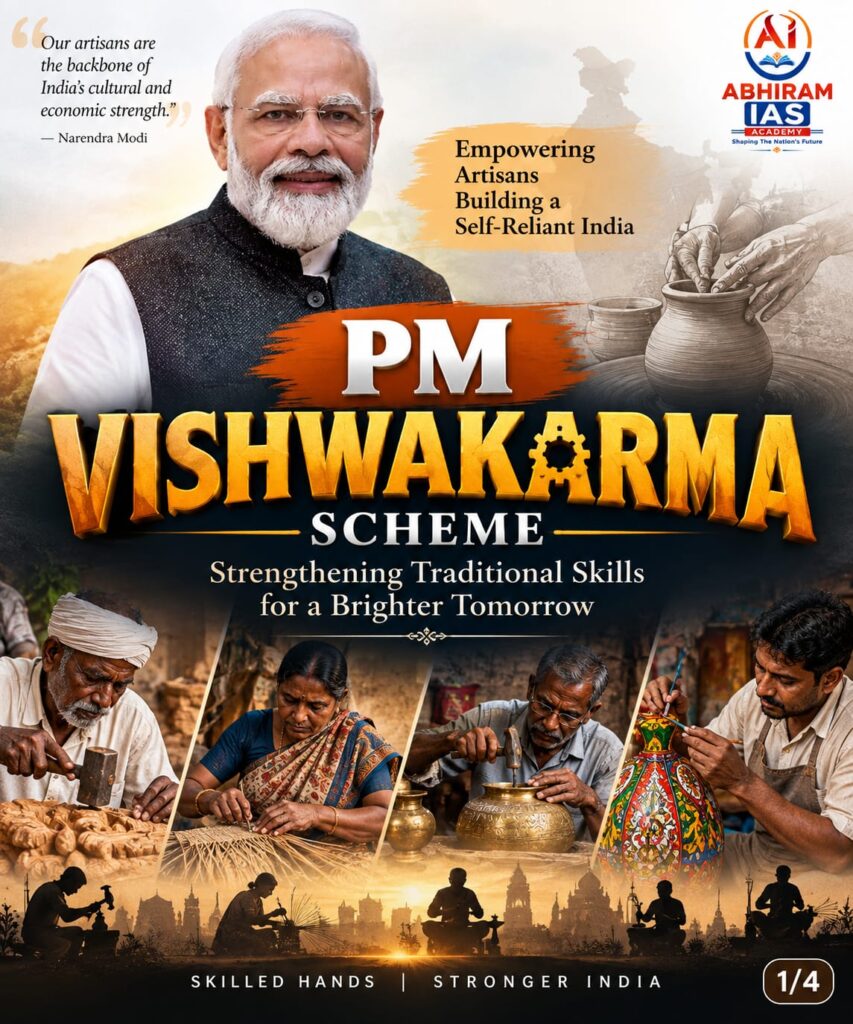
18 September 2026 | Current Affairs | Government Schemes | Economy | MSME
The PM Vishwakarma Scheme has completed three years, emerging as an important current affairs topic for candidates preparing for UPSC Civil Services, SSC CGL, SSC CHSL, SSC MTS, IBPS PO, IBPS Clerk, SBI PO, SBI Clerk, RBI Grade B, NABARD, RRB, Railway NTPC, CDS, NDA, CAPF, EPFO, APPSC Group 1, APPSC Group 2, TSPSC, BPSC, UPPSC, MPPSC, RPSC, MPSC, KPSC, TNPSC, Kerala PSC, OPSC, WBPSC and other State PSC and government examinations.
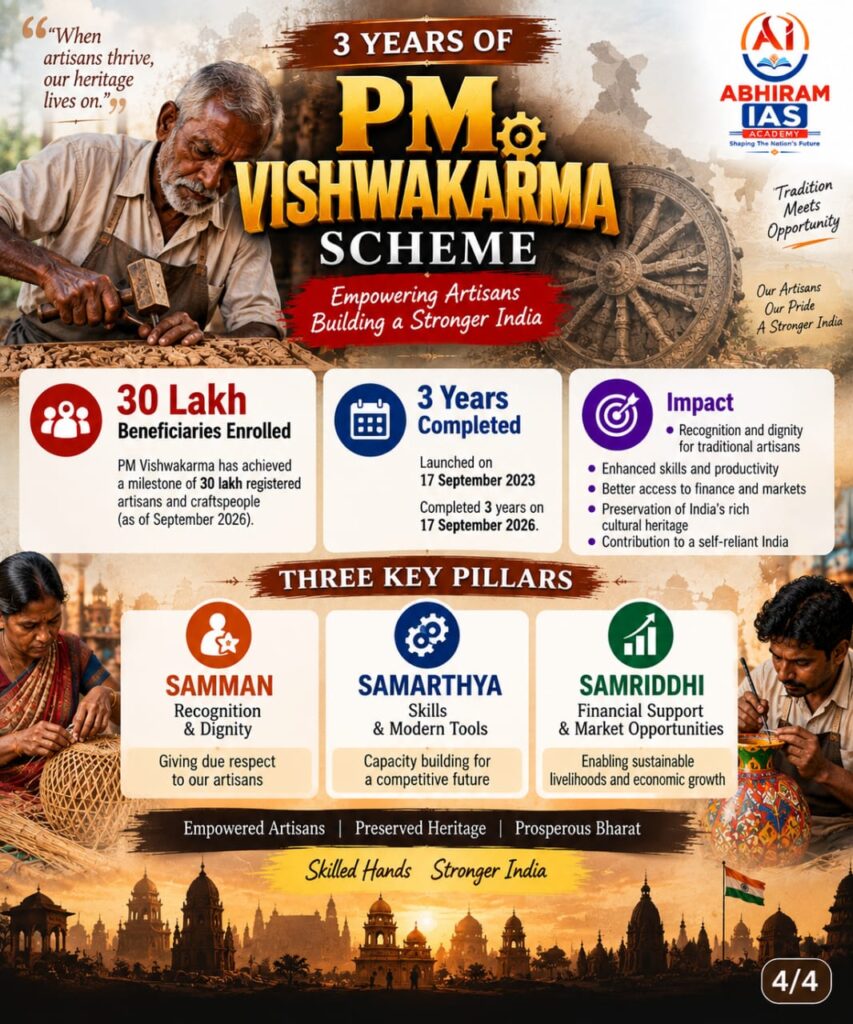
The scheme is in the news because it completed three years on 17 September 2026. According to the Ministry of Micro, Small and Medium Enterprises (MSME), the scheme has achieved its target of 30 lakh registered beneficiaries, while around 24.50 lakh beneficiaries have received basic skill training. (Press Information Bureau)
For competitive-exam aspirants, PM Vishwakarma is particularly important because questions can be framed around its nodal ministry, type of scheme, beneficiaries, 18 traditional trades, financial assistance, skill training, toolkit incentive, digital transactions and credit support.
Why is PM Vishwakarma in News?
The Government of India launched PM Vishwakarma on 17 September 2023 to provide comprehensive support to traditional artisans and craftspeople who work primarily with their hands and tools. On 17 September 2026, the scheme completed three years of implementation.
The Ministry of MSME marked the third anniversary through an event in Kolkata, West Bengal. By the third anniversary, the registration target of 30 lakh beneficiaries had been achieved. The government has also been connecting beneficiaries with platforms such as Udyam Assist, Government e-Marketplace (GeM), e-commerce platforms, trade fairs and exhibitions to improve their access to formal markets. (Press Information Bureau)
What is PM Vishwakarma Scheme?
PM Vishwakarma is a Central Sector Scheme of the Government of India designed to provide end-to-end support to artisans and craftspeople engaged in identified traditional occupations.
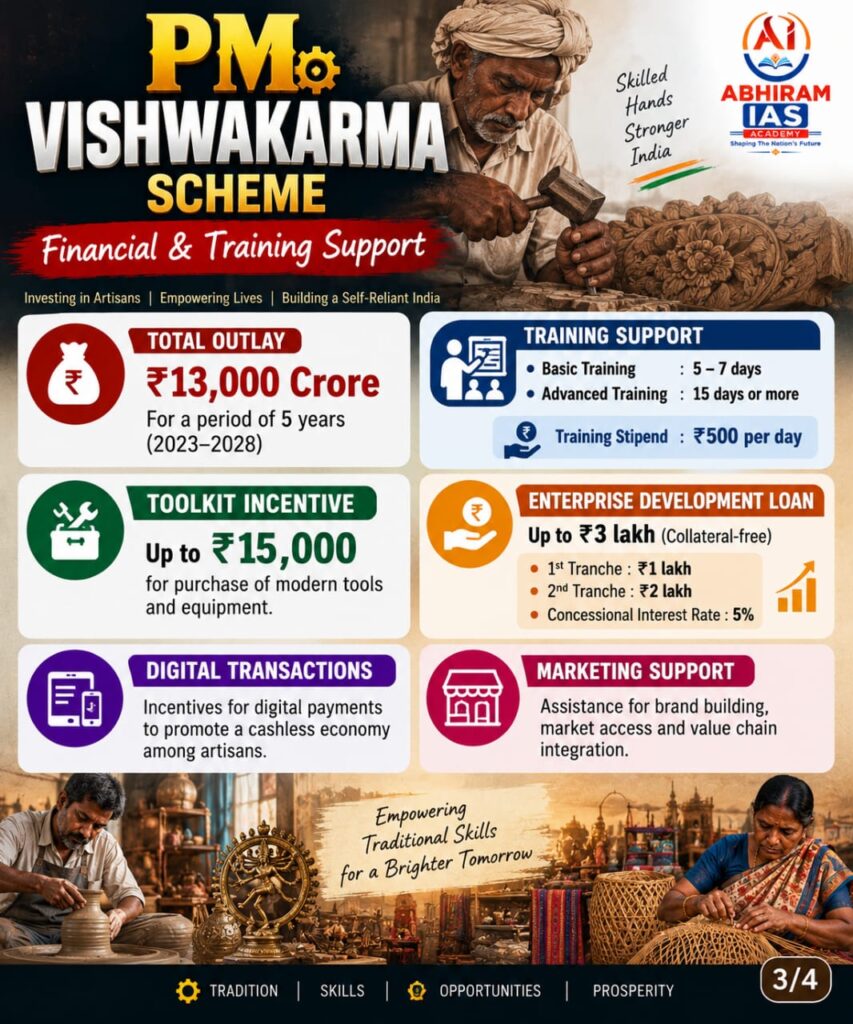
It was launched on 17 September 2023, on the occasion of Vishwakarma Jayanti. The Ministry of Micro, Small and Medium Enterprises (MSME) is the nodal ministry for the scheme. The programme has a total financial outlay of ₹13,000 crore for the five-year period from FY 2023-24 to FY 2027-28. (Press Information Bureau)
The broader objective is not simply to provide financial assistance. PM Vishwakarma seeks to combine recognition, skills, modern tools, affordable credit, digitalisation and market access so that traditional occupations can become more productive and commercially sustainable.
Three Pillars of PM Vishwakarma
The scheme is structured around three broad ideas — Samman, Samarthya and Samriddhi.
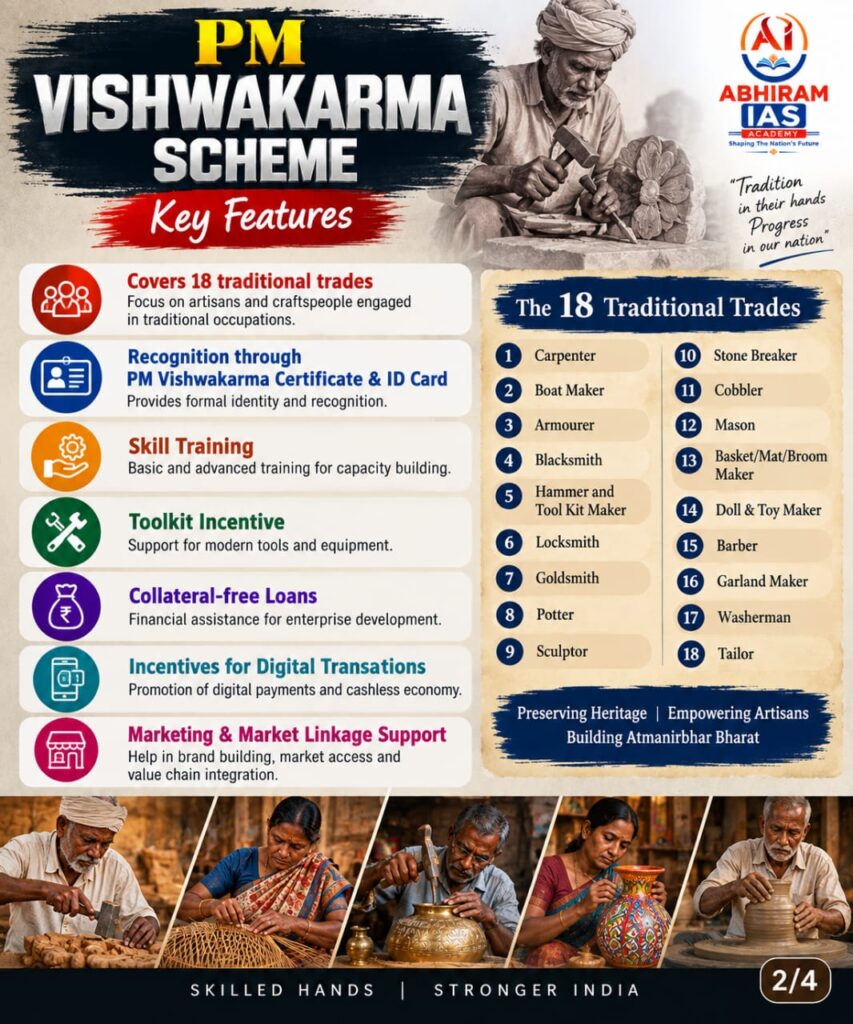
Samman refers to providing recognition and dignity to traditional artisans and craftspeople. Beneficiaries receive a PM Vishwakarma Certificate and ID Card, giving formal recognition to their traditional occupation.
Samarthya focuses on improving their capabilities through skill development, modern tools, training and exposure to better production practices.
Samriddhi focuses on economic advancement by improving access to affordable credit, digital transactions, branding, marketing and wider markets. (Press Information Bureau)
Which 18 Traditional Trades are Covered?
One of the most important facts for competitive examinations is that PM Vishwakarma covers 18 traditional trades.
These include Carpenter, Boat Maker, Armourer, Blacksmith, Hammer and Tool Kit Maker, Locksmith, Goldsmith, Potter, Sculptor/Stone Carver/Stone Breaker, Cobbler/Shoesmith/Footwear Artisan, Mason, Basket/Mat/Broom Maker/Coir Weaver, Traditional Doll and Toy Maker, Barber, Garland Maker, Washerman, Tailor and Fishing Net Maker. (Press Information Bureau)
Exam Alert: Fishing Net Maker is one of the 18 recognised trades. This is an easy area for statement-based or matching questions in Prelims examinations.
Key Benefits Under PM Vishwakarma
The first component is Recognition. Eligible artisans receive a PM Vishwakarma Certificate and ID Card, formally recognising their skills and occupation.
The second component is Skill Upgradation. Basic training generally lasts 5–7 days, while advanced training lasts 15 days or more. Beneficiaries undergoing training receive a stipend of ₹500 per day. (Press Information Bureau)
The third component is the Toolkit Incentive. Beneficiaries can receive up to ₹15,000 through e-vouchers for modern tools and equipment related to their occupation. (Press Information Bureau)
Another major component is collateral-free credit support. Eligible beneficiaries can receive Enterprise Development Loans of up to ₹3 lakh, divided into two tranches. The first tranche is up to ₹1 lakh, while the second tranche is up to ₹2 lakh. The loans are provided at a concessional interest rate of 5% for beneficiaries. (Press Information Bureau)
The scheme also promotes digital transactions and provides marketing support, including assistance related to branding, market access, trade fairs, exhibitions and integration into larger value chains.
PM Vishwakarma at 3 Years: What Has Been Achieved?
The third anniversary provides an important current-affairs update. The scheme has reached the target of 30 lakh registered beneficiaries. According to the Ministry of MSME, around 24.50 lakh beneficiaries had received basic skill training by the third-anniversary celebrations. (Press Information Bureau)
Earlier government data also highlighted substantial progress in skill verification, toolkit distribution and credit delivery. The programme is increasingly focusing on connecting traditional artisans with the formal enterprise ecosystem through Udyam Assist, GeM, e-commerce platforms and market-linkage initiatives. (Press Information Bureau)
This transition is important because traditional artisans often possess valuable skills but may face difficulties in accessing formal credit, technology, branding, digital payments and larger markets.
Why Does PM Vishwakarma Matter for the Indian Economy?
India’s traditional crafts are not merely part of its cultural heritage; they are also an important component of the rural and informal economy. Carpenters, potters, blacksmiths, cobblers, tailors, goldsmiths and other artisans often operate as small household enterprises.
PM Vishwakarma attempts to bridge the gap between traditional skills and the modern economy. By combining training with modern tools and affordable credit, the scheme seeks to improve productivity. By encouraging digital transactions and formal identification, it can support greater integration with the formal economy. Market-linkage initiatives can potentially help artisans move beyond local markets and connect with larger domestic and global supply chains. (Press Information Bureau)
The scheme therefore intersects with several important policy themes such as MSME development, financial inclusion, skill development, self-employment, entrepreneurship, digital inclusion, Make in India, Vocal for Local and Atmanirbhar Bharat.
PM Vishwakarma vs Other Government Schemes
Aspirants should avoid confusing PM Vishwakarma with other employment and entrepreneurship programmes.
PM Vishwakarma primarily targets artisans and craftspeople engaged in 18 identified traditional trades and combines recognition, training, toolkits, credit and marketing support.
PMEGP (Prime Minister’s Employment Generation Programme) focuses more broadly on facilitating the establishment of micro-enterprises through credit-linked assistance.
PM SVANidhi, meanwhile, primarily focuses on providing working-capital support to street vendors.
The beneficiary group is therefore a useful way to distinguish these schemes in objective examinations.
Important Facts for Competitive Exams
Remember this quick revision chain:
PM Vishwakarma → Launched 17 September 2023 → Central Sector Scheme → Ministry of MSME → 18 traditional trades → ₹13,000 crore outlay → 2023-24 to 2027-28 → Certificate & ID Card → ₹500/day training stipend → Toolkit incentive up to ₹15,000 → Collateral-free loans up to ₹3 lakh → 5% concessional interest rate → Digital transaction incentives → Marketing support → 30 lakh registrations by third anniversary. (Press Information Bureau)
What Can Be Asked in UPSC, SSC, Banking and State PSC Exams?
For UPSC Prelims and State PSC examinations, aspirants should focus on whether PM Vishwakarma is a Central Sector or Centrally Sponsored Scheme, its nodal ministry, covered occupations, credit structure and financial outlay.
For SSC, Railway, Banking and other one-day competitive examinations, direct factual questions may revolve around the launch year, ministry, number of trades, ₹15,000 toolkit incentive, ₹3 lakh credit ceiling, 5% interest rate and ₹500 daily training stipend.
For UPSC Mains, State PSC Mains and descriptive examinations, PM Vishwakarma can be connected with themes such as MSME formalisation, inclusive growth, employment generation, traditional knowledge, financial inclusion, skilling, digitalisation and preservation of India’s cultural heritage.
News Explainer: Why is the Scheme Significant After Three Years?
The significance of the third anniversary goes beyond the number of registrations. India’s challenge has traditionally been to ensure that artisans do not remain disconnected from modern finance, technology and markets simply because their occupations are traditional or family-based.
PM Vishwakarma tries to create a progression from recognition → skill development → better tools → affordable finance → digitalisation → market access.
This approach is important because preserving traditional occupations does not necessarily mean keeping them technologically unchanged. Their long-term survival may depend on improving productivity, product quality, branding, design, access to finance and ability to reach modern consumers.
The scheme therefore represents an attempt to connect India’s traditional knowledge economy with its modern entrepreneurial ecosystem.
Conclusion
Three years after its launch, PM Vishwakarma has reached the milestone of 30 lakh registered beneficiaries, making it an important example of India’s efforts to support traditional artisans through a combination of recognition, skills, technology, finance and markets. (Press Information Bureau)
For competitive-exam aspirants, the scheme should not be studied merely as another government programme. It connects several recurring examination themes — MSMEs, informal sector, skill development, financial inclusion, entrepreneurship, digital economy, traditional industries and inclusive growth.
SEO Keywords
PM Vishwakarma Scheme 2026, PM Vishwakarma Yojana, PM Vishwakarma Scheme 3 years, PM Vishwakarma 30 lakh artisans, PM Vishwakarma current affairs 2026, current affairs September 2026, 18 September 2026 current affairs, today current affairs, daily current affairs 2026, government schemes current affairs, MSME current affairs, PM Vishwakarma UPSC, PM Vishwakarma UPSC Prelims, PM Vishwakarma SSC, PM Vishwakarma SSC CGL, PM Vishwakarma Banking Exams, PM Vishwakarma Railway Exams, PM Vishwakarma APPSC, PM Vishwakarma TSPSC, PM Vishwakarma State PSC, UPSC current affairs 2026, SSC current affairs 2026, banking current affairs 2026, APPSC current affairs 2026, competitive exams current affairs, government schemes for competitive exams, 30 lakh beneficiaries PM Vishwakarma, 18 traditional trades PM Vishwakarma, MSME schemes India, current affairs for UPSC SSC Banking Railways State PSC, Abhiram IAS Academy current affairs.