The Moon: Surface Features, Phases, Solar and Lunar Eclipses, Spring and Neap Tides – Complete Geography Notes for UPSC, APPSC Group 1, Group 2 and TGPSC 2027
The Moon, Phases of the Moon, Solar Eclipse, Lunar Eclipse, Spring Tides and Neap Tides are important topics in Physical Geography and General Science for UPSC Civil Services Examination, APPSC Group 1, APPSC Group 2, TGPSC Group 1 and TGPSC Group 2 examinations. Understanding the Moon’s geological features, lunar phases, eclipses and gravitational influence on ocean tides helps aspirants prepare for conceptual and statement-based questions in competitive examinations.
The Moon is Earth’s only natural satellite. It shines by reflecting sunlight and plays an important role in ocean tides and the long-term stability of Earth’s rotational axis. Its cratered surface preserves evidence of impacts and volcanic activity that occurred during the early history of the Solar System.
1. Geological Features of the Moon – Important Geography Concepts for UPSC, APPSC and TGPSC
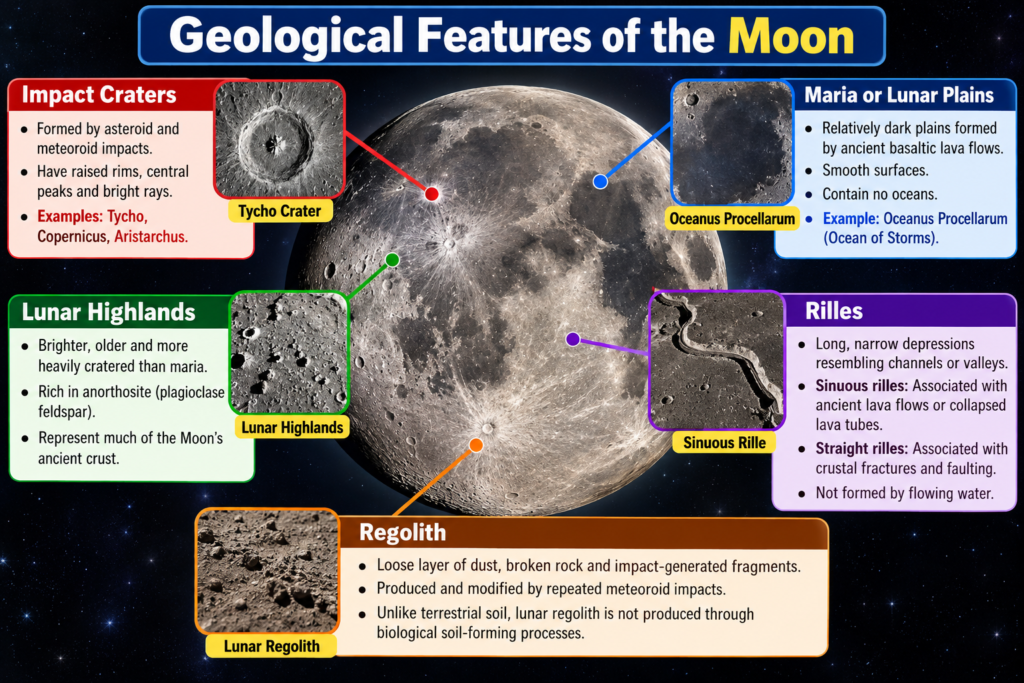
The lunar surface consists of impact craters, dark volcanic plains, elevated highlands, mountains and channels. Because the Moon lacks a substantial atmosphere and flowing surface water, many ancient landforms remain well preserved.
Impact Craters: Most lunar craters formed when asteroids and meteoroids struck the surface at high speeds. Such collisions excavated depressions and scattered material around them, sometimes producing raised rims, central peaks and bright rays. Tycho, Copernicus and Aristarchus are prominent examples.
Maria or Lunar Plains: The maria are relatively dark plains formed by ancient basaltic lava flows. Lava spread across low-lying areas and older impact basins, creating comparatively smooth surfaces. Although their name means seas, they contain no oceans. Oceanus Procellarum, traditionally called the Ocean of Storms, is an extensive dark volcanic region on the Moon’s near side.
Lunar Highlands: The highlands are generally brighter, older and more heavily cratered than the maria. They are rich in anorthosite, an igneous rock dominated by plagioclase feldspar. Their rugged terrain represents much of the Moon’s ancient crust.
Rilles: Rilles are long, narrow depressions resembling channels or valleys. Sinuous rilles are commonly associated with ancient lava flows or collapsed lava tubes, whereas straight rilles are generally associated with crustal fractures and faulting. Their appearance does not indicate erosion by flowing water.
Regolith: Lunar regolith is the loose layer of dust, broken rock and impact-generated fragments covering much of the surface. Repeated meteoroid impacts crush, redistribute and modify this material. Unlike ordinary terrestrial soil, lunar regolith is not produced through biological soil-forming processes.
2. Phases of the Moon – New Moon, Full Moon and Lunar Eclipse Concepts
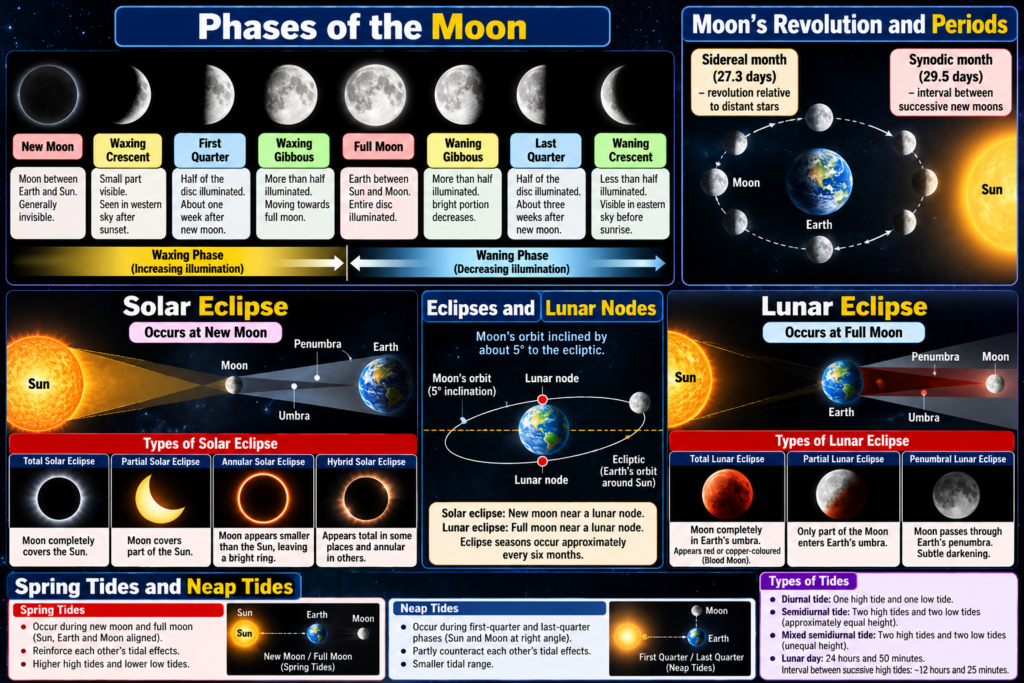
The phases of the Moon are the changing appearances of its sunlit portion as observed from Earth. Approximately half of the Moon is illuminated by the Sun at any time, but its revolution around Earth changes how much of this illuminated hemisphere we can see. Ordinary lunar phases are not caused by Earth’s shadow.
The Moon completes one revolution relative to distant stars in approximately 27.3 days, called the sidereal month. However, the interval between successive new moons is approximately 29.5 days, called the synodic month. This interval is longer because Earth also moves around the Sun.
New Moon: At new moon, the Moon lies approximately between Earth and the Sun. Its illuminated hemisphere faces largely away from Earth, making the lunar disc normally invisible. A solar eclipse can occur at this phase when the alignment is sufficiently close.
Waxing Crescent: A small part of the illuminated hemisphere becomes visible, and the sunlit portion increases each day. The Moon is commonly observed in the western sky after sunset.
First Quarter: Roughly one week after new moon, half of the visible lunar disc is illuminated. The Moon has completed approximately one-quarter of its phase cycle.
Waxing Gibbous: More than half of the visible lunar disc is illuminated, and the bright portion continues to increase as the Moon approaches the full-moon phase.
Full Moon: Earth lies approximately between the Sun and Moon, and nearly the entire visible lunar disc is illuminated. The Moon generally rises around sunset and sets around sunrise. A lunar eclipse is possible during this phase.
Waning Gibbous: After full moon, more than half of the visible disc remains illuminated, but the illuminated fraction gradually decreases.
Last or Third Quarter: Approximately three weeks after new moon, half of the visible lunar disc is illuminated again. This phase is associated with neap tides.
Waning Crescent: Less than half of the visible disc is illuminated, and the bright portion continues to shrink until the Moon returns to the new-moon phase.
The boundary between the illuminated and dark portions of the Moon is called the terminator. This boundary provides strong contrasts that make craters and mountains easier to observe.
3. Solar Eclipse and Lunar Eclipse – Types, Differences and Important Facts
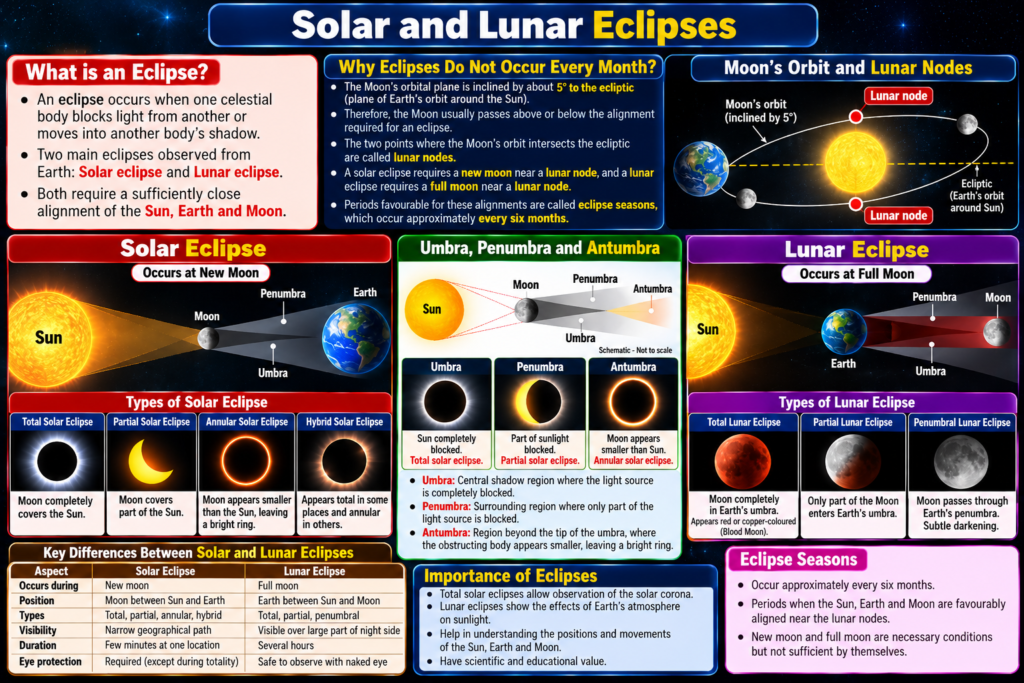
An eclipse occurs when one celestial body blocks light from another or moves into another body’s shadow. The two principal eclipses observed from Earth are solar eclipses and lunar eclipses.
The Moon’s orbital plane is inclined by approximately 5° to the ecliptic, the plane of Earth’s orbit around the Sun. Consequently, eclipses do not occur every month. The points where the Moon’s orbit intersects the ecliptic are called lunar nodes.
A solar eclipse requires a new moon near a lunar node, whereas a lunar eclipse requires a full moon near a lunar node. Periods favourable for these alignments are called eclipse seasons, occurring approximately every six months.
Umbra: The central shadow region where the light source is completely blocked.
Penumbra: The surrounding region where only part of the light source is blocked.
Antumbra: The region beyond the tip of the umbra, where the obstructing body appears smaller than the light source, leaving a bright ring visible around it.
Solar Eclipse
A solar eclipse occurs when the Moon passes between the Sun and Earth and casts its shadow on part of Earth’s surface. It can occur only during the new-moon phase.
Total Solar Eclipse: The Moon completely covers the Sun’s visible disc for observers within the path of totality. The sky becomes considerably darker, and the solar corona becomes visible.
Annular Solar Eclipse: The Moon appears too small to cover the Sun’s entire disc, producing a bright ring of sunlight commonly called the Ring of Fire.
Partial Solar Eclipse: The Moon covers only part of the Sun’s disc. It is observed from regions within the Moon’s penumbra.
Hybrid Solar Eclipse: The eclipse appears total along some sections of its central path and annular along others. Such eclipses are relatively uncommon.
Direct observation of the Sun during partial phases or an annular eclipse requires appropriate solar-viewing protection. Ordinary sunglasses are unsuitable.
Lunar Eclipse
A lunar eclipse occurs when Earth lies between the Sun and Moon and the Moon passes through Earth’s shadow. It can occur only during the full-moon phase.
Total Lunar Eclipse: The entire Moon enters Earth’s umbra. Some sunlight passes through Earth’s atmosphere and is refracted into the shadow, causing the Moon to appear red, orange or copper-coloured. This appearance is commonly called a Blood Moon.
Partial Lunar Eclipse: Only part of the Moon enters Earth’s umbra, producing a dark curved shadow across a portion of the lunar disc.
Penumbral Lunar Eclipse: The Moon passes through Earth’s penumbra without entering the umbra. Its surface undergoes a relatively subtle reduction in brightness.
Unlike solar eclipses, lunar eclipses can be safely observed with the naked eye. Their wider geographical visibility makes them easier to witness from a particular location.
Key Differences Between Solar and Lunar Eclipses
| Solar Eclipse | Lunar Eclipse |
|---|---|
| Occurs during new moon | Occurs during full moon |
| Moon lies between Sun and Earth | Earth lies between Sun and Moon |
| May be total, partial, annular or hybrid | May be total, partial or penumbral |
| Totality follows a narrow geographical path | Visible over a large part of Earth’s night side |
| Totality at one location lasts a few minutes | The complete event may last several hours |
| Requires appropriate eye protection outside complete totality | Safe to observe without special eye protection |
4. Spring Tides, Neap Tides and the Moon’s Influence on Earth’s Climate
Tides are the periodic rise and fall of sea level produced mainly by the gravitational influences of the Moon and Sun. Although the Sun is far more massive, the Moon exerts the stronger tide-generating influence because it is much closer to Earth.
Tides arise from differences in gravitational attraction across Earth. In a simplified model, two tidal bulges develop, one on the side facing the Moon and another on the opposite side. Earth’s rotation produces alternating high and low tides.
Actual tidal patterns are modified by coastline shape, ocean depth, continental barriers and the configuration of ocean basins.
Spring Tides: Spring tides occur around new moon and full moon, when the Sun, Earth and Moon are approximately aligned. Their tidal effects reinforce one another, producing a relatively large tidal range. Spring tides generally produce higher high tides and lower low tides. The term spring has no connection with the spring season.
Neap Tides: Neap tides occur around the first-quarter and last-quarter phases, when the directions of the Sun and Moon form approximately a right angle as viewed from Earth. Their tidal effects partly counteract one another, producing a smaller tidal range.
Diurnal Tides: A diurnal tidal pattern consists of one high tide and one low tide during a lunar day.
Semidiurnal Tides: A semidiurnal pattern consists of two high tides and two low tides of approximately equal height during a lunar day.
Mixed Semidiurnal Tides: A mixed semidiurnal pattern consists of two high tides and two low tides of unequal height during a lunar day.
A lunar day lasts approximately 24 hours and 50 minutes. In an ideal semidiurnal pattern, successive high tides are separated by approximately 12 hours and 25 minutes.
Tides influence marine ecosystems, fishing, navigation, harbour operations, sediment movement and tidal-energy generation. Tidal currents also contribute to ocean-water mixing.
The Moon and Earth’s Climate
The Moon helps stabilise Earth’s axial tilt, contributing to the relative stability of seasonal patterns over long geological periods. Its gravitational influence limits large variations in the orientation of Earth’s rotational axis. However, this does not mean Earth’s tilt remains completely fixed or that the Moon prevents climatic changes.
The Moon also influences oceans through tidal currents and mixing, which help redistribute heat, nutrients and dissolved substances.
Transits, Occultations and Scientific Significance
A transit occurs when a relatively small celestial body appears to move across the visible disc of a larger body. Mercury and Venus can transit the Sun as viewed from Earth.
An occultation occurs when a foreground body hides a more distant object from view. A solar eclipse involves the Moon occulting the Sun, whereas a lunar eclipse involves the Moon entering Earth’s shadow.
Eclipses have considerable scientific value. Total solar eclipses permit observations of the solar corona, while lunar eclipses reveal the effects of Earth’s atmosphere on sunlight reaching the Moon.
Importance for UPSC, APPSC and TGPSC Preparation
For aspirants preparing for UPSC Prelims 2027, APPSC Group 1 Prelims, APPSC Group 2, TGPSC Group 1 and TGPSC Group 2, understanding lunar phases, eclipses, tidal forces, the Moon’s geological features and its influence on Earth strengthens conceptual preparation in Physical Geography and General Science.
At Abhiram IAS Academy, Ashok Nagar, Hyderabad, aspirants can strengthen their preparation through structured classes, comprehensive study material, exam-oriented test series and mentorship for UPSC, APPSC and TGPSC examinations.
Start your UPSC, APPSC and TGPSC preparation with Abhiram IAS Academy.
Website: www.abhiramias.com
Contact: 9908764576 | 9908937111
Location: Ashok Nagar, Hyderabad