
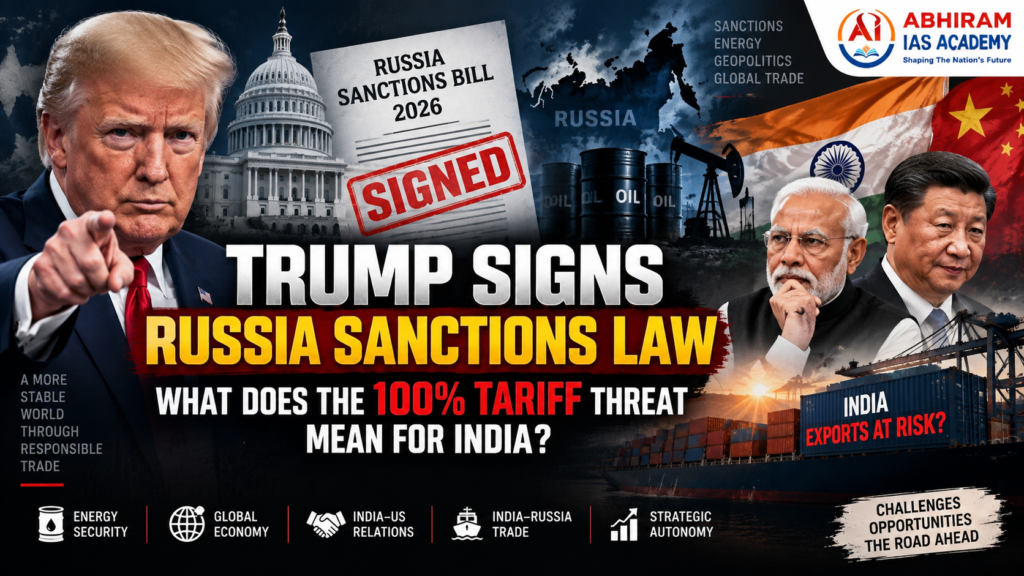
Trump Signs Russia Sanctions Law: What Does the 100% Tariff Threat Mean for India?
19 September 2026 | Current Affairs | India–US Relations | India–Russia Relations | Economy & Energy Security
US President Donald Trump has signed new Russia sanctions legislation, bringing India into focus because the law allows the United States to impose tariffs of up to 100% on countries buying Russian oil and gas. India and China are among the major buyers of Russian energy, making the development important for global trade, energy markets and international relations. The legislation had earlier passed the US House of Representatives by a 262–159 vote.
However, one distinction is crucial: the US has not automatically imposed a blanket 100% tariff on all Indian goods. The new law creates the authority to impose tariffs of up to 100% under its secondary tariff provisions. The actual impact on India will depend on how the US administration exercises these powers and what tariff rates are subsequently announced.
Why is India Affected?
The issue is closely linked to India’s imports of Russian crude oil. After the Russia–Ukraine war began, India significantly increased purchases of Russian crude, partly because of competitive prices and the need to ensure stable energy supplies.
The new US sanctions framework seeks to put economic pressure not only on Russia but also potentially on third countries that continue major energy transactions with Moscow. This is where the idea of secondary sanctions or secondary tariff pressure becomes important.
In simple terms:
Russia earns from energy exports → Other countries buy Russian oil → US uses tariff pressure on those buyers → Objective is to reduce Russia’s energy revenues.
What is a Tariff?
A tariff is a customs duty imposed on imported goods. If the US imposes a higher tariff on Indian products, those goods could become more expensive in the American market.
This does not mean that India simply pays a “fine” to the US. Instead, higher tariffs can affect the competitiveness of Indian exports, potentially reducing demand or forcing exporters to adjust prices.
What is the Challenge for India?
India faces a difficult balance between energy security and trade interests.
Russian crude can help India diversify energy supplies and manage import costs. But if continued Russian oil purchases lead to higher US tariffs, some Indian exports could face greater pressure in the American market.
The challenge can therefore be understood as:
Russian Oil → Energy Security & Import Costs
versus
US Tariffs → Export Competitiveness & Trade Interests
Any major disruption in crude supplies can also affect India’s oil import bill, inflation, current account and domestic fuel-price management.
What Has India Said?
India has emphasised its commitment to ensuring energy security for its 1.4 billion people and said that sourcing decisions would continue to reflect market conditions and diversification. It has also conveyed that measures affecting Russian oil trade could have implications for both bilateral relations and the wider international energy market.
Why is Strategic Autonomy Important Here?
For UPSC and State PSC aspirants, the most important concept connected with this development is Strategic Autonomy.
Russia remains an important long-term strategic partner for India, while the United States is a major partner in trade, technology, defence, investment and the Indo-Pacific.
India therefore has to balance:
India–Russia Relations + Energy Security + India–US Partnership + Trade Interests + Strategic Autonomy
This makes the issue much more than a simple tariff dispute. It illustrates how geopolitics can directly influence a country’s economic and energy choices.
Why is This Important for Competitive Exams?
This topic is relevant for UPSC Civil Services, APPSC Group 1, APPSC Group 2, TGPSC/TSPSC, BPSC, UPPSC, MPSC, MPPSC, RPSC, KPSC, TNPSC, OPSC, WBPSC and other State PSC examinations, particularly under International Relations, Indian Economy and Energy Security.
For SSC CGL, SSC CHSL, Railways, Banking, RBI, NABARD, CDS, NDA, CAPF and other competitive exams, focus on the countries involved, Russia sanctions, tariffs, secondary sanctions and the India–Russia energy relationship.
Quick Revision for Exams
Donald Trump → New Russia Sanctions Law → Pressure on Russian oil and gas revenues → Tariffs of up to 100% possible on countries covered by the Russian energy provisions → India is potentially affected because of Russian crude imports → India stresses Energy Security and protection of trade interests.
Important Current Affairs Trap:
“US has already imposed a blanket 100% tariff on India” — Incorrect.
The legislation enables tariffs of up to 100% under specified provisions; their actual application to India depends on subsequent US decisions.
Conclusion
The new US Russia sanctions law is not merely a Russia–Ukraine war development. For India, it connects energy security, India–US trade, India–Russia relations, global oil markets and strategic autonomy.
India’s central policy challenge will be to secure affordable and reliable energy supplies while protecting its export interests and maintaining strategic relationships with both Russia and the United States.
SEO Keywords
Trump Russia Sanctions Bill 2026, Trump 100% Tariff India, US Tariff on India 2026, India Russia Oil Latest News, Russian Oil Sanctions India, India US Relations 2026, India Russia Relations 2026, Russia Ukraine War Current Affairs, Strategic Autonomy India, Energy Security India, Secondary Sanctions, Tariff Meaning, UPSC Current Affairs 2026, APPSC Current Affairs 2026, APPSC Group 1 Current Affairs, APPSC Group 2 Current Affairs, SSC Current Affairs 2026, Banking Current Affairs, Railway Current Affairs, State PSC Current Affairs, Current Affairs Today, 19 September 2026 Current Affairs, Daily Current Affairs, General Knowledge 2026, GK Today, Competitive Exams Current Affairs, International Relations Current Affairs, Abhiram IAS Academy Current Affairs.